
Harley Davidson Vintage Motorcycles Wall Art, Shrimp Burns, Wrecking Crew METAL Sign
Harley Davidson Vintage Motorcycles Wall Art, Shrimp Burns, Wrecking Crew METAL Sign


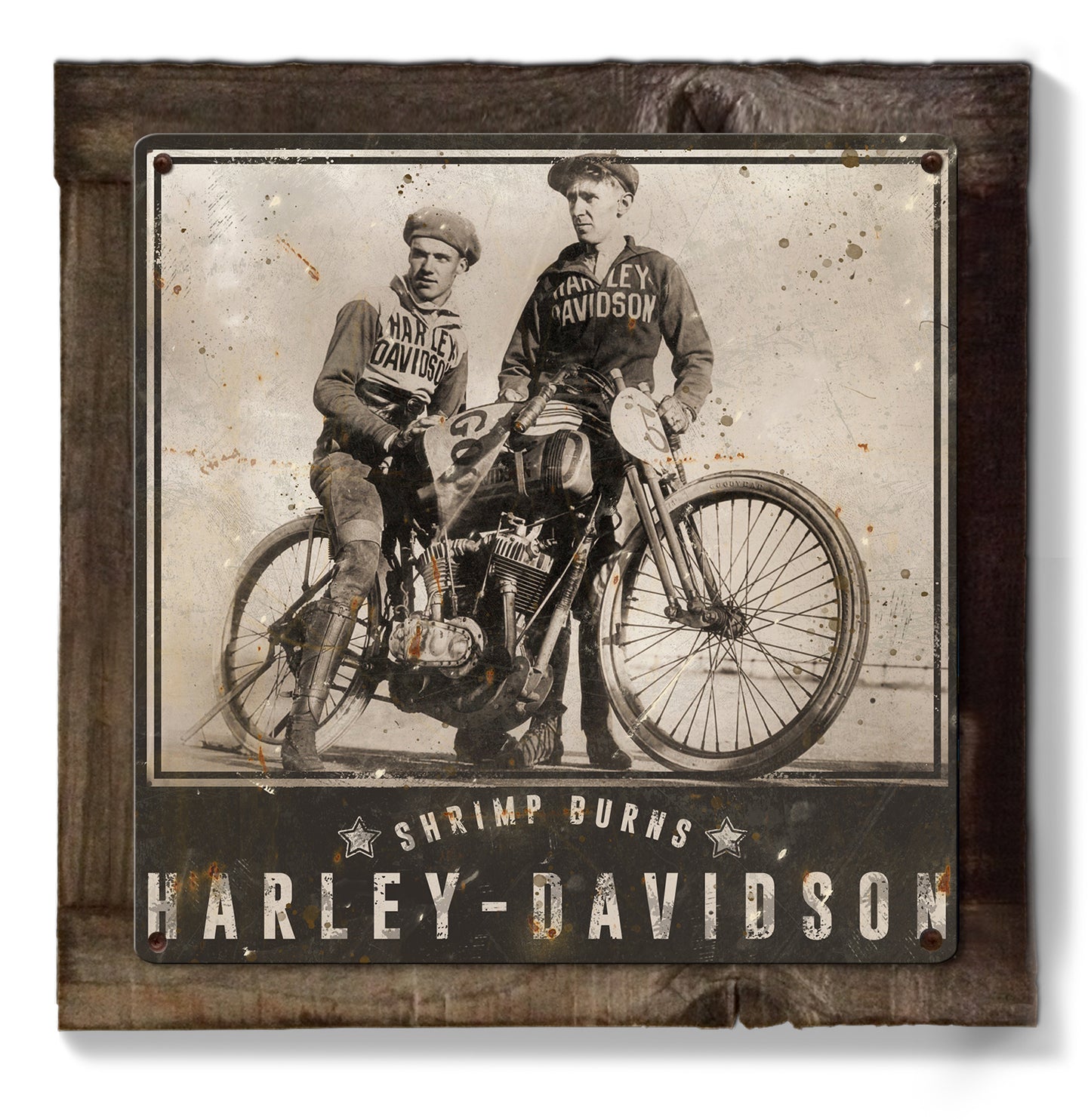
Rare Harley Davidson Shrimp Burns Metal Sign is made from heavy gauge American steel (No Flimsy Tin Here). Select from three different sizes: Large, Medium, Small. Also, available with an optional rustic wood frame (See Options Below). Designs are baked into a powder coating for a durable finish. Unlike other tin signs, canvas prints, and posters, our metal signs will not bend, fold, dent, or wrinkle over time. You can take a hammer to our signs. Our signs are hand made just like in the days. Rest assured these metal signs are made to last.
Great wall decor for motorcycle enthusiast, offices, living rooms, industrial lofts, garages, man caves, government buildings, restaurants, bars and more.
-----------------OPTIONS-----------------
SIZE OPTIONS: *SIZES ARE ALL APPROXIMATE
(The wood frame option adds a 1-2" border to the total size of each panel. )
• Large - Measures a 24" x 24"
• Medium - Measures 18" x 18"
• Small - Measures 12" x 12".
FRAME OPTIONS:
• Wood Frame - Each framed panel comes mounted on wood with rustic screws for an authentic look and feel. Also Comes with a small saw tooth metal hanger on the rear, ready to hang.
The wood frame adds a 1-2" border to the total size of each panel.
• No Frame - Metal signs with no frame have each corner drilled and riveted for easy hanging.
------------------------------------------------------
Albert “Shrimp” Burns and an unidentified team pit man, M&ATA 200 Mile National Championship race at Ascot Park, June 22, 1919.
What is it about these old machines that captivates us after all of these years? Is it the raw engineering of their power, the elegant simplicity of their purpose? The machines, the weapons in the original arms race of speed, have become icons in their own right. The pioneers who ran them wide open and, on occasion, beyond their limits are true legends of American motorsport. Their ironclad determination, be it on the dirt or the boards, etched their names into the history of our culture, and the rare images that survived have immortalized the moments when titans once rode among us.
Pictured here is the Albert “Shrimp” Burns (and a yet identified pit man) from his brief but triumphant tenure on Harley-Davidson’s legendary factory racing team, the Wrecking Crew. The teenaged Burns made a name for himself, racing around California before WWI, honing his skills while the war interrupted the sport, only to emerge as its brightest star once racing resumed in 1919. Bill Ottaway, engineer, and director of the factory racing program at Harley-Davidson, took note and, in June 1919, signed Burns to a contract riding for the Motor Co.
This photo comes from that moment, Burns’ first professional race as a member of the legendary Harley-Davidson Wrecking Crew. Held at the old Ascot Park on June 22, 1919, the M&ATA 200-Mile National Championship was dominated by Harley-Davidson. In what was a parade of Milwaukee iron across the line, Burns and his new team closed out every place first through fifth. Ralph Hepburn took the grand prize, covering the 200 miles in just over 2 hours and 45 minutes at an average speed of 72 mph. Burns came in fourth, taking home $150 and a prime position on America’s greatest racing team. He commanded the 1919 season for Harley but, after less than six months, left the team to the surprise of many, kicking off the 1920 season at the same track riding for Harley’s main rival, Indian.
"Shrimp" Burns was one of the top dirt and board track racers of the 1910s and early '20s. The diminutive Burns rode for both the Harley-Davidson and Indian factory teams during his career. He was the youngest champion of his era, winning his first titles at the tender age of 15.
Known for his tenacity, Burns was always a crowd favorite. Fellow competitor Wells Bennett noted that Burns took the turns with his tongue hanging off to the side of his mouth as if to give him extra balance. He was a gritty and determined rider who often rode injured.
Burns was born in Oakdale, California, on August 12, 1898. His family moved to Oakland when Albert was a toddler and that is where Burns grew up and went to school. As a youngster, Burns' favorite place to hang out was a local Pope motorcycle dealership. At first, the managers of the shop chased Burns away for meddling with the bikes parked in front of the shop, but later they relented and hired the 12-year-old as a shop helper.
One day when the owner was out to lunch, the temptation was too great for Burns and he sneaked out on a Pope lightweight and rode around the block. Before long Burns was allowed to run messages for the shop and occasionally was even allowed to borrow a machine for Sunday afternoon rides.
World War I brought a temporary stop to Burns' racing career. Early in 1919, Burns came home to win one of the first major West Coast races after the war in Fresno, California. In June of that year, Harley-Davidson signed the 20-year-old rider to his first factory contract.
With Harley-Davidson, Burns was able to show his talent outside of his native California. On July 4, 1919, Burns made his first appearance on the East Coast, riding a national meet in Baltimore. Burns, who rode in an unusual style by hugging the inside rail around the circuit, won a five-mile solo race as well as a sidecar event. The Baltimore performance set him on the road to gaining a reputation as one of the country's best racers. Burns spent much of the summer of 1919 on a winning streak in Midwest races and even gave the legendary Gene Walker a serious challenge in Atlanta, something no rider had been able to do against the South's almost unbeatable rider.
Switching teams to follow the money, Burns left Harley-Davidson and rejoined Indian.
On August 14, 1921, Burns tragically lost his life in a racing accident in Toledo, Ohio. Coming out of a turn, Burns ran into the back of Ray Weishaar's bike. The impact sent Burns into the railing and he later died of massive head injuries. Sadly, Burns' fiancée, Genevieve Moritz, had come to Toledo to deliver a birthday gift and stayed to watch the race and witnessed the fatal accident. Motorcycling deeply mourned the loss of Burns. Numerous tributes were written about him for weeks after the accident.
Harley Davidson Vintage Motorcycles Wall Art, Shrimp Burns, Wrecking Crew METAL Sign
| Width | No |
|---|---|
| Height | No |
| Type | Metal Sign |
| License | Metal Sign Barn |